

“Running has taken me on adventures great and small, at home and around the world. It has provided me with hope and perseverance on days when I had none—and even, once every great while, warmed me with that fleeting ray of sunshine known as glory. Running has taught me that I can do anything, just so long as I keep putting one foot in front of the other. Sometimes that notion is metaphorical and sometimes not. In this way, I have been inspired to attempt things I would have never dreamed possible. And it all started with a single step.”
– Martin Dugard

October 10, 2021
Today was the day I was supposed to be toeing the line of the Chicago Marathon. I had waited for this day for almost three years having deferred in 2019 due to a broken foot and getting deferred in 2020 due to COVID.
I had started my own training cycle on June 1, 2021 with the goal of running my marathon PR, possibly even qualifying for Boston, and running marathon #30 better than any other race before.
It was exciting to have goals again, and I’m a girl who loves having a plan. The structure of the Peloton Outdoor Marathon Training Plan gave me structure, boxes to check and excitement as the weeks passed.
I was less than two months away getting ready for my 16-mile long run over the weekend. The fall semester was about to start, and despite still having to navigate the new protocols related to COVID, I felt excited and happy. Even though I was in the prime of it being 2000 degrees and humid outside (think Alabama and August), nothing beat running down that trail with the trees on either side of me. I was pretty darn confident this would be my best race yet.
I wouldn’t have guessed that I would have been the one to contract a breakthrough case of COVID. And it was bad. Really bad.
I barely moved for close to two weeks, short of getting the dog outside. I relied on friends to drop off food, even though I couldn’t taste it, and I laid in bed zooming into everything I possible could.
Physically, I was in bad shape. Mentally, I was in worse shape. Emotionally, about the same as the other two. I felt like I was already straddling a very precarious place of being in a bad mental state because of the isolation, the protocols, and the uncertainty. I felt like I had been extra cautious because my dad was not in a good place health-wise, and I wanted to be able to travel to see him in very short notice if the circumstance arose. Getting COVID literally shocked me.
I went from training to barely moving, and that’s a tough place for me to be in.
Running has always been a diversion from me. I ran from pain–emotional and mental; I ran to think things through–work, dissertations, research projects, teaching innovations, relationships, parenting decisions; I ran as a mechanism to give myself the space to get my life together so I could actually come back to the real world and have my life together, or at least pretend to.
After running my first 26.2 as an adult (two marathons while in college, but I am not counting those for this), I knew moving forward I could do anything. If I could literally get myself to run, sometimes with walks but run, 26.2 miles in a couple of hours, I could do anything. I always fell back on that when I needed myself to be my own hype girl.
Running a marathon and then the next and the next and the next taught me that I was capable of doing anything. I just had to believe I could do it. The pros and coaches always say, marathon running is about 30% physical and 70% mental. It’s a head game, and so much of life is a head game. The number of times I got into situations and thought, ok, you can do this. You have run 32 miles in one day so you can legit do X,Y,Z. I’ve said that to myself a lot.
The ChiTown Marathon 2021 was going to be marathon #30 for me, and quite possibly my very last one. After two weeks of COVID with very little movement toward feeling significantly better, I told myself I was going to withdraw from the race as I absolutely did not want to toe the line to just face disappointment. I struggled to get up the stairs to my second floor so there was no reason to believe I’d be able to slug it out for four hours or more on a race course. Before I had the chance to overthink it, which I tend to do, I submitted my withdrawal from the 2021 marathon.
In the grand scheme of things, not running a marathon is definitely a first-world problem. In the grand scheme of things, it could be a lot worse, so I really need to get over myself and stop whining about not running.
But, here’s the catch: in just the two months since I was diagnosed with COVID, I saw a significant decline in my mental health. I was struggling. Part of it was having COVID, part of it was having to work through the challenges associated with teaching college students in a pandemic, and a big part of it was I lost my outlet. Without having running, I wasn’t able to get a lot of my frustrations out on the pavement or a trail, and it just built up. I was angry, I was sad, I was alone, and at times, really not in a good place.
I think most of us have struggled these last 18 months, and we’ve all had to find ways to cope. Whatever that way is, when it gets taken away, what seems like a very small matter can become a very big matter.
I only recently began acknowledging what a toll the last year and a half had taken on me. I saw others who were struggling and realized I was too. Whatever I was feeling was ok, and I certainly don’t need to be putting on a performance for anyone else’s sake. But, the articulation of how I was feeling was a very new thing. I had previously run it out, or so I thought, and not being able to do so showed me how important it was to acknowledge that it ain’t always perfect, and that’s perfectly fine.
As Dugard notes in the quote at the top, running inspired me to do things I never thought I would ever do. Running taught me to believe in myself. Running taught me I could literally get through anything and remain upright (I have had some pretty tough races–more on that in another post).
As I was digging through the bowl where I have kept many of my running medals looking for my 2012 Chicago Marathon medal, I stopped to look at all of the 26.2, 13.1, 10k, 5k, and even ultra marathon medals. I had almost forgotten about some of the races. As I ran my fingers across the top of some of them, I got a nice dose of perspective. I have been so fortunate to have been able to run all of these races, see beautiful places, meet some of the best people, get inspired by even better people, and truly have an opportunity to witness grit at its finest.
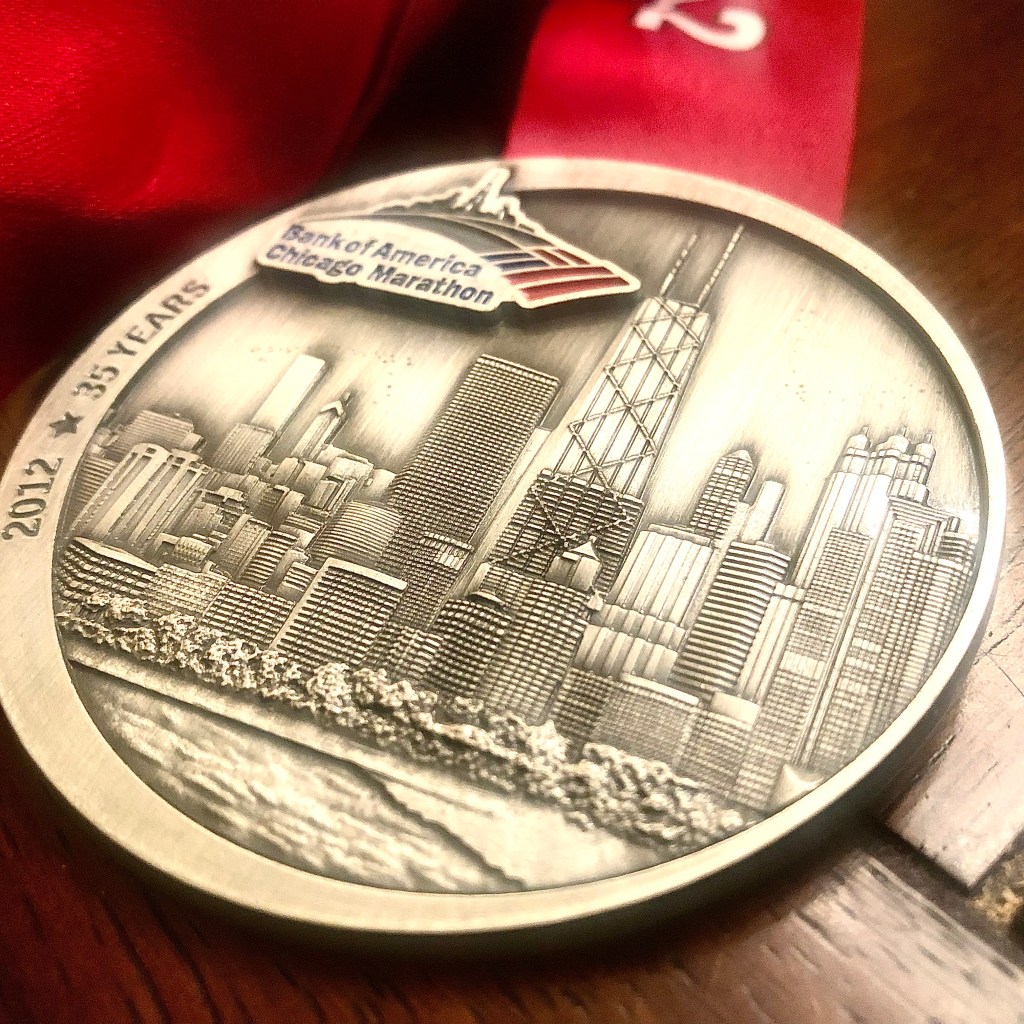
So, a few points to bring this to a close: 1. Acknowledge that it’s World Mental Health Day, and wherever we are in our own lives and with our own mental health, sometimes it is helpful to know others are out there who are sharing similar thoughts and feelings. So with that, please take this as my acknowledgement of my struggles and my willingness to let ;others know they are not alone 2. Acknowledge my gratitude for all that I have been able to do up to now. I survived COVID, and while it’s had several lingering effects, I survived COVID and more than 700,000 people have not. 3. Acknowledge that it’s not over. I can get back out there and re-start this attempt to run marathon #30. Wherever the place, whenever the time, I can get back out there. And I will.
The only thing holding me back is me, and I know I can do hard things.
“Running is not just for those who are fit and healthy and strong. Running is a life-breathe for those who struggle with physical and mental illness, self-doubt, loss, anger, regret and other unspeakable pains. Why? Because running has the power to heal, to bring perspective, to instill confidence, to restore sanity and to make us believers again. This is why I run.”—Susan Husband


